Your weekly label order sheet arrives: fifty different SKUs, each with unique shapes, three different material thicknesses, and quantities ranging from 500 to 50,000 pieces. You walk onto the production floor and look at your die cutting station. One machine—but two fundamentally different ways to cut labels. Which method should you reach for?
This guide walks through the technical and financial trade-offs between rotary and flatbed die cutting for label finishing. By the end, you will have a practical decision framework that ties the choice directly to your order structure—not to which method is “better” in the abstract.
Both rotary and flatbed die cutting perform the same core job—separating label shapes from the web—but they do it through fundamentally different mechanisms.
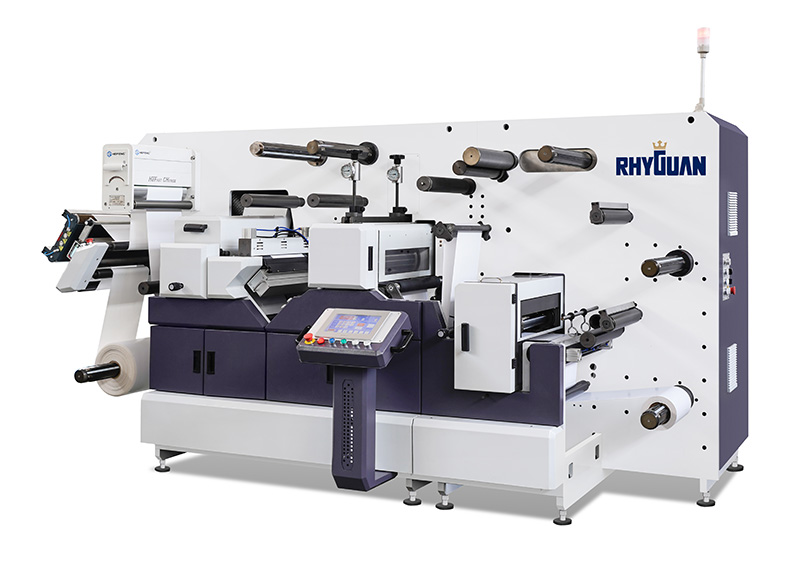
Rotary die cutting uses a cylindrical die mounted on a rotating magnetic cylinder. The material feeds continuously between the die cylinder and a mating anvil cylinder; as the cylinders rotate in sync, the cutting edges shear through the label material. Think of it as a roller that never stops—the material moves, the die spins, and cuts happen continuously at speed.
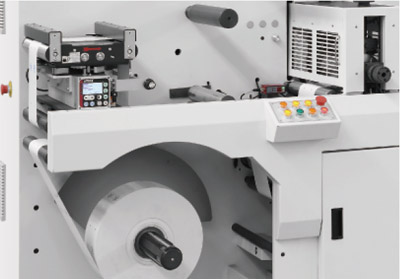
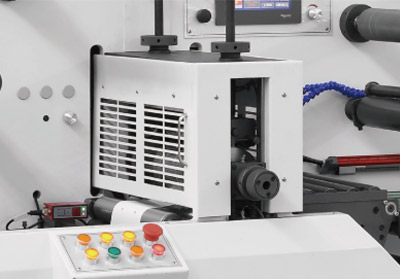
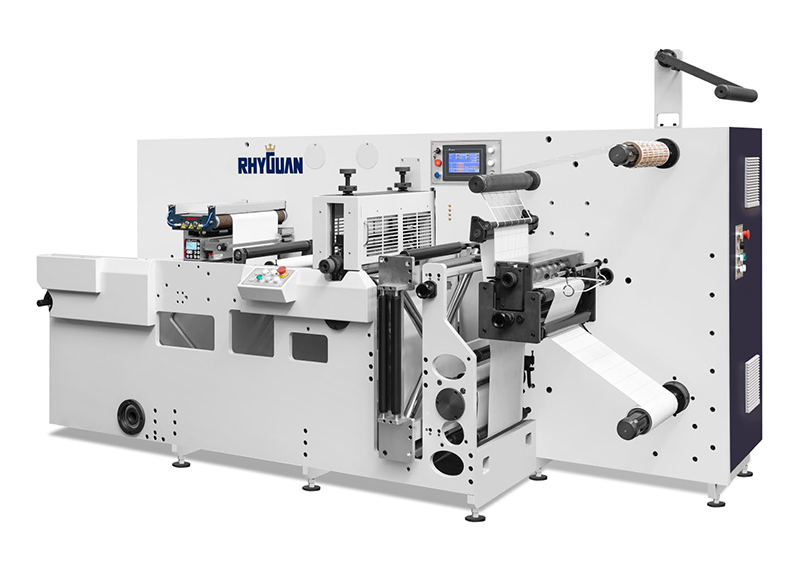
Flatbed die cutting takes a completely different approach: a flat steel-rule die is pressed vertically down onto a stationary material surface in a stamping-like motion, then lifts up before the material advances to the next position. This intermittent, stop-and-go operation is mechanically simpler but inherently slower.
Why does this matter for your daily production? The continuous motion of rotary cutting allows for uninterrupted roll-to-roll processing without the start-stop cycles that introduce setup waste. Every time a flatbed machine stops for sheet indexing or tool changes, you lose 5–10 meters of substrate per restart—waste that multiplies across jobs. For high-volume runs, those lost meters translate directly into margin erosion.
Learn how rotary die-cutting machines handle complex multi-station continuous processing? Click https://www.rhyguan.net/rotary-die-cutting-solutions.
The real choice comes down to how these two methods perform across three critical production metrics.
| Comparison Factor | Rotary Die Cutting | Flatbed Die Cutting |
|---|---|---|
| Typical tooling cost | $500–$2,000 per die | $30–$150 per steel-rule die |
| Tool changeover time | 20–40 minutes | 10–15 minutes |
| Design modification cost | High—must re-machine the die | Low—quick die board modification |
| Per-unit cost at 10,000m+ run | Low – tooling amortized over huge volume | Medium – slower output increases labor cost |
The tooling gap is the single biggest financial differentiator. A flatbed steel-rule die can be made locally for $30–$50; if the design changes, you scrap it and order another for the same low cost. This makes flatbed virtually risk-free for prototyping, seasonal promotions, or any situation where label shapes change frequently.
Rotary dies require precision machining on magnetic cylinders—costs that only make sense when the run is large enough to amortize that upfront investment over thousands or millions of labels. For a shop producing 50 new label designs per week with runs of 500 pieces each, rotary tooling would be financially unsustainable. For a plant running 500,000 blank thermal labels weekly, the tooling cost per label becomes negligible.
What this means for your daily operation: If your job mix includes a high number of custom shapes with low quantities per SKU, flatbed keeps your tooling budget under control. If you have a stable portfolio of high-volume designs, rotary tooling pays for itself through speed.
Industry data shows that properly calibrated rotary systems achieve waste rates of 2–4%, compared to 8–12% for manual or semi-automatic flatbed setups. On a $50,000 material order, that 6–8% difference in waste alone can cover two months of machine payments. Rotary systems also reduce labor cost per unit by 60–70% on runs exceeding 5,000 pieces, as continuous feed replaces manual load-unload cycles.
Flatbed machines typically run at 30–50 meters per minute, while rotary equipment cruises at 100–150 m/min. For a 10,000-meter job, rotary finishes in roughly one-third the time—savings that translate directly into capacity, not just speed.
| Material Type | Rotary Die Cutting | Flatbed Die Cutting |
|---|---|---|
| Standard paper/cardstock | Excellent | Good |
| Thin films | Excellent – consistent kiss-cut | Moderate – risk of tear |
| Thick materials | Poor – risk of edge compression | Excellent – vertical shear |
| Multi-layer / specialty substrates | Moderate | Excellent – even pressure across stack |
Flatbed’s vertical “guillotine” action cuts straight down through the material, making it the only choice for thick foam, rigid board, or multi-layer composites where rotary’s rolling action would compress edges.
How can flatbed die-cutting provide precise control for thick materials or custom labels with complex shapes? Click https://www.rhyguan.net/flatbed-die-cutting-solutions.
Instead of comparing machine specs, look at your invoices. Here is how to match method to order profile:
Your average order: 500–5,000 labels per SKU, 20+ die changes per week, constant new shapes and custom promotions.
Best fit: Flatbed die cutting.
Why: Low tooling cost per design protects your margins. Quick changeovers keep throughput acceptable despite lower line speed.
Your average order: 50,000–500,000 labels per SKU, stable designs, minimal die changes across weeks.
Best fit: Rotary die cutting.
Why: High throughput drives down unit labor cost. Tooling expense amortizes over massive volumes. Lower waste rates deliver significant material savings.
Your materials include thick board, textured wine label paper, foam, or multi-layer composites. Precision matters more than pure speed.
Best fit: Flatbed die cutting, potentially with inline capabilities.
Why: Rotary struggles with thick or rigid substrates. Flatbed’s even pressure and vertical cut ensure clean edges on materials that rotary cannot handle.
(https://youtu.be/FawvCUr05QE?si=pL8FC_HZymDwYNsa)
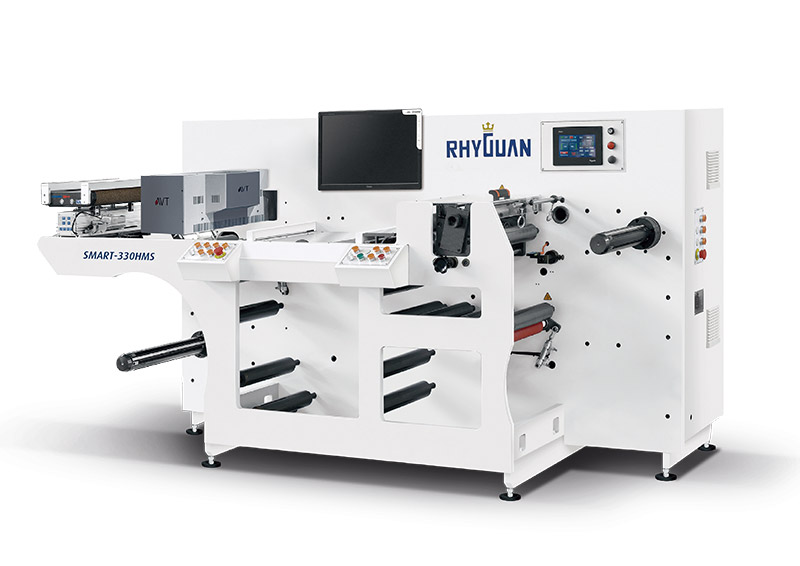
A third consideration emerges when looking beyond the die cutting station alone: inline finishing. For high-volume label production, integrating rotary die cutting directly with printing and slitting into a single pass eliminates the hidden costs of offline processing. Each time a roll moves from printer to standalone die cutter to slitter, you incur setup waste, labor redundancy, and increased material handling risk.
Industry benchmarks indicate that integrated converting systems typically deliver full ROI within 12–18 months, driven by 40–60% reduction in labor costs and significantly lower material waste during job setups. For plants running predominantly high-volume rotary work, this integration path can amplify the efficiency advantages further.
Neither rotary nor flatbed die cutting may be the optimal choice for the fastest-growing segment of the label market: short-run, high-variability custom jobs. The global print label market reached $51.9 billion in 2025 and is projected to expand to $77.8 billion by 2034, with digital printing and on-demand customization driving much of this growth. Short-run label orders now hold a significantly larger market share compared to bulk production orders.
For runs under 500–2,000 pieces where die tooling costs cannot be justified, laser die cutting offers a tool-less alternative that supports on-demand shape changes without physical dies. This is not a replacement for mechanical die cutting—laser speeds are slower and per-unit costs at scale are higher—but for converters serving boutique brands, seasonal packaging, or prototyping needs, digital cutting should be part of the evaluation alongside rotary and flatbed options.
Learn how laser die-cutting can handle short-order, customized needs without the need for molds. Click https://www.rhyguan.net/contact-us.
The choice between rotary and flatbed die cutting for labels is not about which technology is inherently superior. It is about aligning the method with your actual order structure—your run lengths, your die change frequency, your material range, and your waste tolerance.
Use this three-question filter before your next equipment decision:
Under 5,000 meters → flatbed favors tooling economics. Over 10,000 meters → rotary’s speed advantage dominates.
Multiple times daily → flatbed’s low-cost tooling wins. Once weekly or less → rotary’s throughput justifies the die expense.
Thin films, paper, self-adhesive labels → both work, but rotary excels at continuous feed. Thick board, foam, textured papers → flatbed is the only viable option.
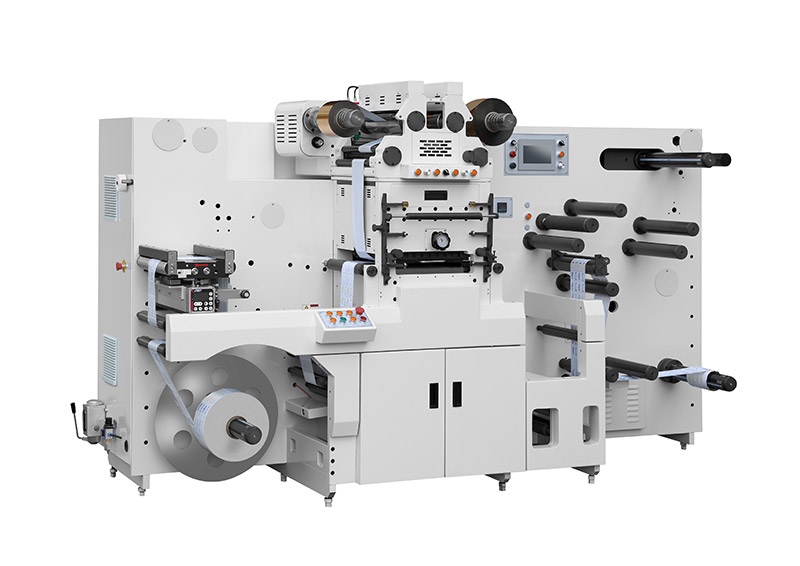
Once you have clarified these decision factors, comparing specific equipment configurations becomes the next logical step. You can review Rhyguan’s rotary die cutting series for high-volume label finishing applications, or explore the flatbed solutions designed for specialty, short-run, and thick-material label production. For converters balancing both order profiles, evaluating modular systems that support multiple die cutting modes may offer the most flexible long-term solution.
How to Choose Between Semi-Rotary and Full-Rotary Die Cutting for Short-Run Labels
5 Signs Your Label Finishing Line Is Ready for Inline Integration
Laser vs. Mechanical Die Cutting: When Tool-Less Cutting Makes Financial Sense
Material Guide: Which Label Substrates Work Best with Rotary vs. Flatbed Methods
Understanding Die Tooling Lifecycles: When to Replace and When to Re-sharpen
This article is part of Rhyguan’s technical content library. No direct sales or pricing information is included. All technical discussions aim to help you make informed purchasing decisions.
● Another PLUS-330 Machine Installed in Latin America
● Another Two Installations at Customers’ Site
● Rhyguan Plus Month
● Top security level in Rhyguan
● Another Rotary Die-cutting Installation at Cutsomer’s Site
● Perfect Factory Acceptance Testing for Label Inspection Machines
● New Rhyguan Factory Preview
● Rhyguan Industrial 4.0 Live Presentation
GET A QUOTE